In 2026, the restaurants that win in Canada won’t be the ones with the cutest “new menu drop.” They’ll be the ones that run tighter location-by-location fundamentals: clear value without constant discounting, rock-solid Google visibility per store, a repeat-guest engine (email/SMS/loyalty), and content that answers real questions so Google and AI tools can confidently recommend them. This matters more now because cost pressure is still real, and guests are more careful with spending.
Most multi-location operators I talk to aren’t short on ideas. They’re short on time, and they’re tired of marketing that looks busy but doesn’t move revenue. That’s exactly what we see with restaurant owners in Canada—high operating costs, labor challenges, heavier competition, and limited time to “keep up” online.
Below is the 2026 playbook we’re using inside Brand To Table: specific, repeatable, and built for multi-location reality.
1) The 2026 shift: marketing is becoming “answerable,” not just “searchable”
In 2026, a lot of guests will not click your website first. They’ll see a Google result, a map pack, a “what’s happening” section, or an AI summary and decide in seconds. If your info is incomplete or inconsistent, you simply won’t get picked.
What “answerable” means (in plain language):
- Your location details are easy to trust (hours, address, phone, links, reservations).
- Your menu is current and readable (not a blurry PDF).
- Your reputation looks active (recent reviews + real owner responses).
- Your pages answer common questions clearly (parking, allergens, private dining, large groups).
This is Answer Engine Optimization (AEO) in restaurant terms: make it easy for Google and AI to quote you accurately.
2) The 6 things multi-location Canadian restaurants should prioritize in 2026
Priority A: Stop “discount panic.” Build a value ladder instead.
Discounting can spike traffic, but it can also train guests to wait for deals. In 2026, you need structured offers that protect margin and staff sanity.
A simple value ladder that works for multi-location:
- Entry value (always-on): a lunch combo, happy hour bundle, or fixed-price quick option
- Mid-tier: limited-time features that rotate (weekly)
- Premium: chef’s table, tasting menu, experiential nights, or curated pairings
What we see in execution: restaurants do better when the offer is operationally easy (same prep, predictable timing) and clearly explained online.
Measure: contribution margin by offer, not just sales.
Priority B: Treat Google Business Profile as a “storefront,” not a listing
For multi-location operators, Google is often the first impression per location. If one store is messy, it drags the brand down.
Google is also rolling out more ways to show specials/events directly on profiles (“What’s happening”), which is huge for slow days—if you use it.
2026 non-negotiables per location:
- Correct primary category + secondary categories
- Updated hours (including holidays)
- Menu link that goes to the correct location page
- Fresh photos monthly (not once a year)
- Post/events weekly when you need traffic
- A review response system (not random replies)
Measure: direction requests, calls, website clicks, and reservation clicks per location.
Priority C: Midweek traffic needs a system, not “post more”
Most multi-location groups don’t struggle on Friday. They struggle Monday–Wednesday.
A midweek system we use:
- Pick one midweek problem (ex: Tuesday dinner is dead).
- Build one repeatable hook (ex: “Tuesday Date Night Set Menu”).
Put it in three places every week:
- Google (“What’s happening” / posts)
- Email/SMS
- One social post + one story reminder
Don’t change the offer every week. Change the angle and keep the operation stable.
Measure: covers by daypart, not just weekly totals.
Priority D: First-party data is your insurance policy
Algorithms change. Platforms change. Costs change. Your guest list is the asset you keep.
In 2026, you need a clean, ethical pipeline:
- QR at table (clear reason to join)
- A real welcome offer (not gimmicky)
- A monthly “what’s on” email per brand + optional location segmentation
What we see across restaurants: the ones who consistently email/sms (without spamming) are less dependent on last-minute promos.
Measure: repeat visit rate, email/SMS-driven reservations, and frequency of visit.
Priority E: Reputation management is now an operations tool
Reviews are not “marketing feedback.” They’re free QA.
Also: guests are using reviews to confirm value before they spend. That’s especially important when prices are higher and patience is lower.
Use reviews like this:
- Track top 3 complaints per location monthly
- Assign each complaint to an ops fix (not a social fix)
- Reply to reviews with specifics (not “Thanks for your feedback!”)
Measure: star rating stability + complaint frequency trendline.
Priority F: Build “AEO pages” that answer the questions AI pulls into summaries
If you want ChatGPT-style tools to recommend you, you need pages that are easy to cite.
High-citation pages every multi-location group should have:
- One page per location (unique content, not copy-paste)
- Private dining page (capacity, menu styles, lead time, inquiry form)
- Catering page (minimums, delivery zones, timing)
- Allergy + dietary page (how you handle it, what guests should do)
- Parking/transit page per location if it’s a common question
This aligns with how guests actually search—and how AI tools summarize options.
Measure: conversions from those pages (calls, forms, reservations), not raw traffic.
3) The 2026 AEO Checklist (per location)
Use this table as your monthly standard operating checklist.
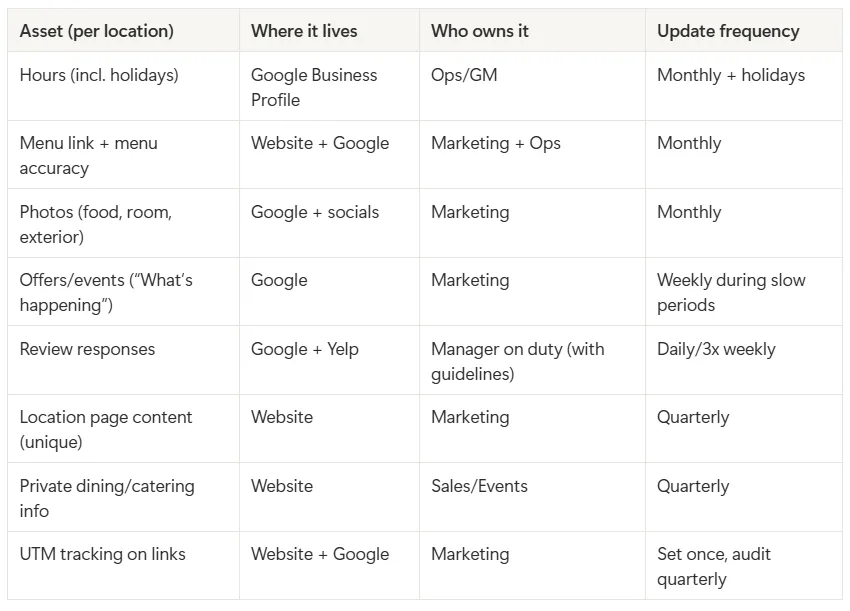
4) What we’re seeing across restaurants we support (the execution patterns)
These are the patterns we see when restaurants actually get results (not vanity metrics):
- The operators who win don’t “do everything.” They choose 2–3 plays and run them consistently for 90 days.
- One weak location page can break trust for the whole brand. Multi-location means your worst listing becomes your first impression.
- The best marketing is operationally boring. Same cadence. Same places. Same measurement. That’s how you get repeatable traffic.
That’s the Brand To Table approach: simple systems that hold up under real restaurant pressure.
FAQ: 2026 Restaurant Marketing Questions (Canada, Multi-Location)
Do I still need a website if Google shows everything?
Yes. Google helps guests decide fast, but your website is where you control the full story: private dining, catering, brand trust, and accurate location details. Also, AI tools pull from structured, consistent sources—your site is a key one.
How many reviews do we need per location each month?
Aim for a steady flow, not spikes. Consistency signals “this place is active.” If you’re multi-location, set a realistic target per store and track it like an ops metric.
Should each location have its own social media account?
Only if you can post and engage consistently. Otherwise, keep one brand account and use location tagging + location-based content. Your Google profiles matter more for local discovery anyway.
What’s the fastest way to improve visibility in 30 days?
Fix Google Business Profile basics per location (hours, categories, menu link, photos), then run one weekly offer and publish it in Google posts. It’s the quickest “show up and look credible” move.
What should I track weekly in 2026?
Per location:
- calls, direction requests, website clicks from Google
- reservations/covers by day of week
- offer performance (margin + sales)
- review volume + top complaints
Closing: The 2026 goal isn’t louder marketing. It’s tighter fundamentals.
If you run multiple locations in Canada, 2026 is the year to standardize what works, location by location—so you’re not relying on hype, trends, or last-minute discounting to hit your numbers.
If you want more practical playbooks like this, keep exploring Brand To Table. And if you want help building the systems behind it—Google visibility, midweek traffic offers, content that gets cited, and a repeat-guest engine—that’s the work we do every day at Great Work Online.